In-Store Audits
Verifying Strategies at the Shelf
Audit is not a formality
Every category strategy and every pricing strategy sounds perfectly logical in a conference room.
In Excel, margins match, segments are clear, and the planogram looks consistent.
The real test, however, begins at the shelf.
That's why, for me, an in- store audit isn't just a formal inspection. It's a critical element of the retail profitability management process.
I've worked in retail for over three decades – not only as an advisor, but previously as an operational manager and P&L manager. I know there's always tension between strategy and execution: staffing constraints, time pressure, and local interpretations of central decisions.
What do in-store audits examine?
The retail audits I conduct include a full analysis of the shelf and its alignment with strategy:
- category structure in the context of its defined role,
- compliance of pricing with the pricing architecture,
- clarity of price ladders in the real shelf layout,
- actual execution of planograms,
- visibility of margin-driving and premium segments,
- private label exposure,
- shelf productivity per linear meter and m².
This isn't a checklist of standards. It's an analysis of shelf economics.
Audit outcomes
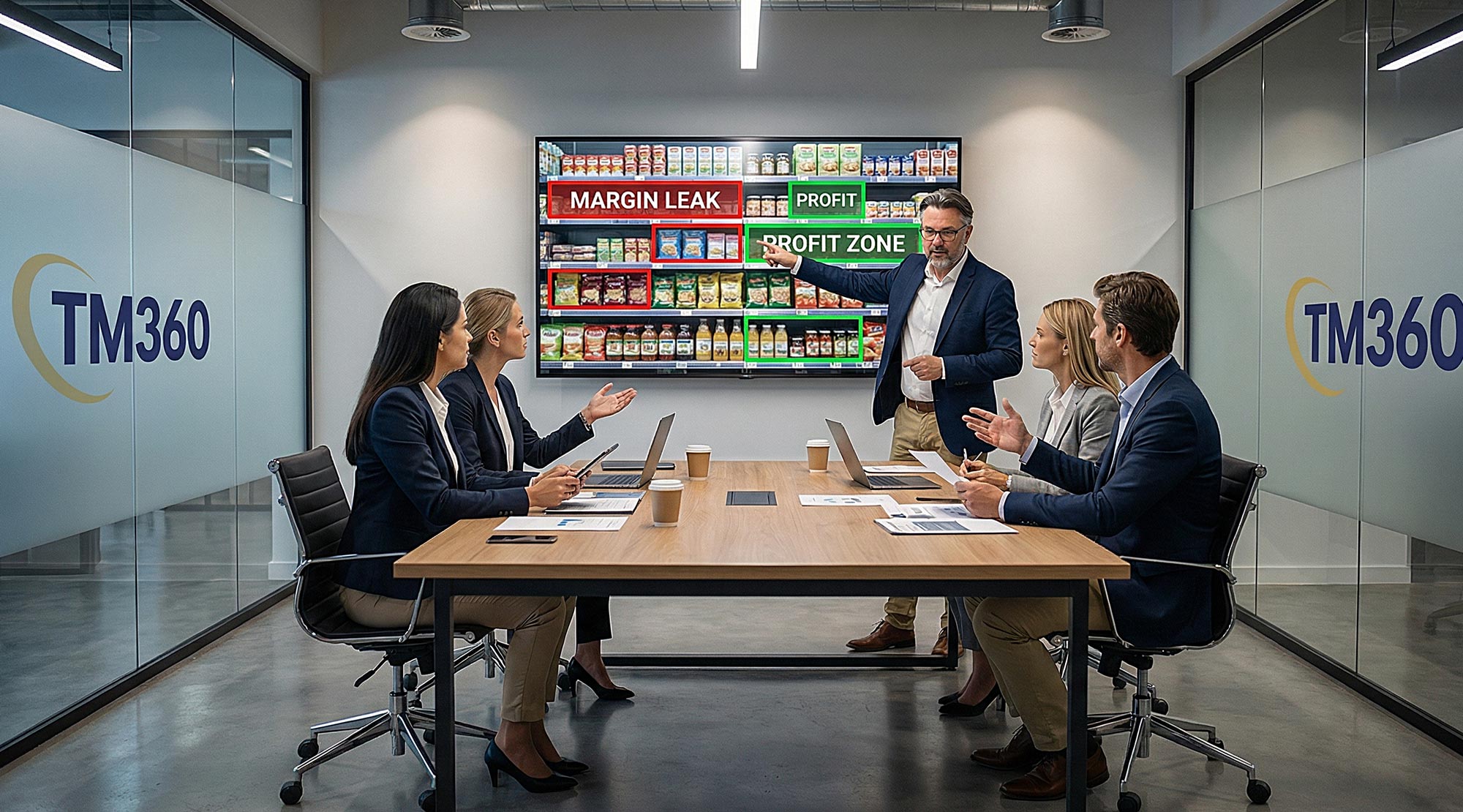
Audits often expose margin leaks that aren't visible in sales reports. The premium segment is invisible. Highest-margin products sit outside the natural line of sight. The price ladder is theoretically correct, but visually unclear. Promotions cannibalize regular sales.
This is the moment of confrontation between strategy and operational reality.
This is where you can see whether the CMF360° model has been implemented systematically or whether it has remained a concept.
In-store audits allow you to:
- identify real profitability losses at the shelf level,
- analyze conversion in the context of layout and price,
- verify alignment between central decisions and local execution,
- harmonize standards across the entire chain,
- build a culture of accountability for category performance.
For management, a retail audit is a tool for evaluating the quality of strategy.
For operational teams, it's a tool for learning and improvement. For me, it's the point where theory meets practice.
A strategy that doesn't work at the shelf isn't a strategy.
It's a presentation.
That's why, in my projects, in-store audits aren't just an add-on.
They're an integral part of the transformation process and a key verification tool for the CMF360° implementation effectiveness.
Because category profitability isn't created at headquarters.
It's devised in a matter of seconds – at the shelf.
Ready to Improve Your Category Performance?
Identify margin leakage, optimize pricing, and build a category strategy that works in real retail conditions.
Quick Link
Contact Us
Roman Szymczak - TM360 Ltd
Aleja Jana Pawła II 27
00-867 Warsaw, Poland